Friday, January 31, 2014

Poor John.

January 30, 2014:
forensics quiz:
A twenty-year old man was found supine of Thompson Creak Trial with a bullet wound. The entrance of the wound was on the left lateral side 1 cm above the third rib. The exit wound was 5 cm above the belly button in the umbilical region. While tracing the bullet path you notice at the entrance the bullet travels in the frontal plane with a 45-degree downward angle. On inspection of the right side of the rib cage by x-ray you observe the 8th rib fractured. Fragments of the bullets are then traced to the final exit wound. What is the leading differentiation diagnosis (and why) and what are three plausible alternatives and how would you rule them out.

                                                                 
What happened.
Someone paid the best assassin in Claremont to kill this man. This twenty-year old man was a Senior at Harvey Mudd at the time. He was the top student here and many people despised him because of his good looks and overall perfection. Anyone could have called for him to be killed. Anyone.
Back to the story. The twenty-year old entrepreneur was going out for his routinely morning jog when he was shot. By inspecting the bullet wounds, we can easily tell that the assassin shot him from above. How? Might you ask. The assassin hid in one of the trees and waited for his prey. He used a gun with a silencer so that nobody would be drawn to the scene by the sound of the gunshot. Once shot, there are a few ways that he could have died.
  1. The bullet could have punctured the heart. If his heart were to have been punctured, many other surrounding organs would have been gravely affected also. He died because of internal bleeding, blood loss, and the fact that the heart was not longer pumping blood. The cause of his broken rib was also the bullet. The bullet went through his heart, hitting his 8th rib, and deflecting off and out of his body.
  2. Another possible case was that the bullet punctured the liver, which then would have released toxins in the body that would have pretty much poisoned him from the inside. This would've been how he died. The broken rib could have been caused by his impact with the ground.
  3. This is the least likely of these three to have occurred, but here it goes. The bullet goes in and misses all vital organs and goes straight to the eighth rib. It hits the rib, breaking it, and then the bullets splits into two, one piece leaving the body above the belly button, while the other would have deflected into the lung. The lung then would've filled up with various fluids, and he would've died, being unable to breathe. Again, the broken rib could have been caused by his impact with the ground.
The second two couldn't really have been ruled out, but the first one was the most probable to actually have happened.

Sunday, December 15, 2013

Super Duper Free Extra Credit

So I was given these two pictures.


And was asked to determine the phenotype of the father of these cute pups. Soooo what we know...

There are 12 puppies.
The Mother is a yellow.
5 of the pups are brown.
The remaining 7 are black.

So right off the bat, we know that mom has to be:
    eebb
    eeBB
    eeBb
We also know that the offspring are about half brown half black. So we have to find a pair of parents that result in half:
    Eebb / EEbb
and half:
    EEBB / EEBb / EeBb / EeBB

So after fiddling around with a few Punnet Squares, I found that:


The Fathers Phenotype must be EEBb.

Saturday, December 14, 2013

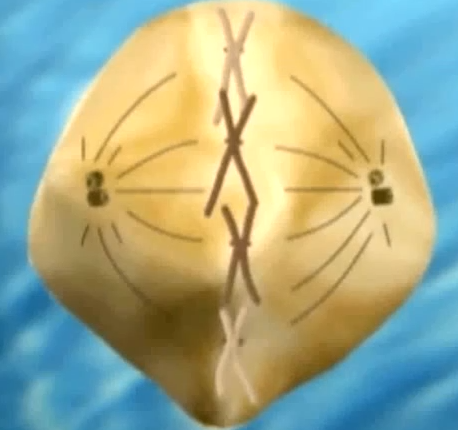
Mitosis and Meiosis

Here are some notes that I took on Mitosis and Meiosis


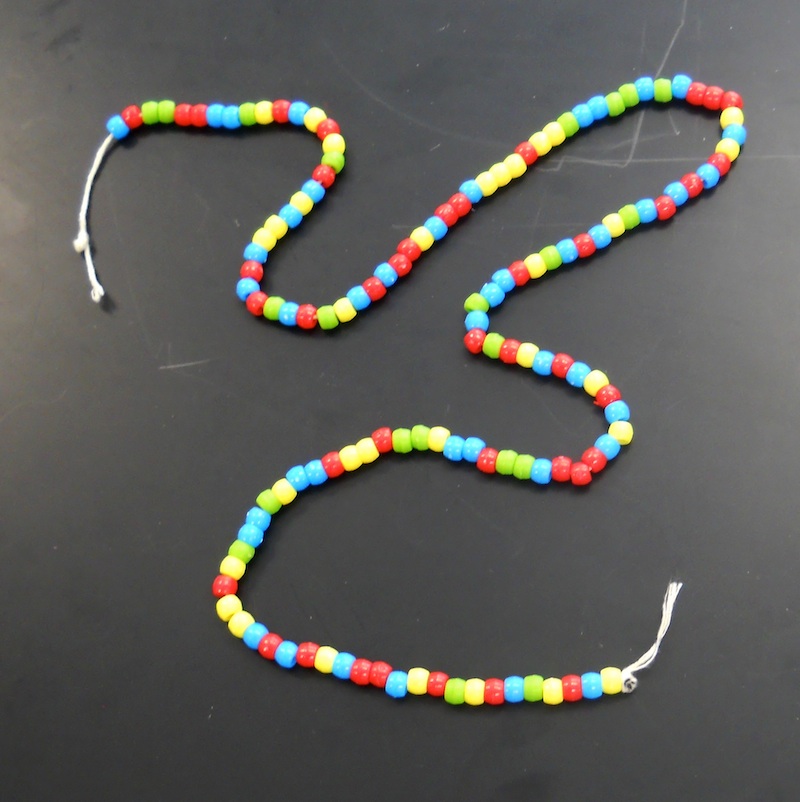
A chromosome is just coiled up DNA
S phase of Replication of DNA

Replicates the other side of the chromosome
 
     Sister Chromatids are connected by Centromere
     Split the sister chromatids to get two single chromatids

Mitosis
Interphase
G1
   Growth
   Normal living
S
   Protein Synthesis
   DNA Replication
G2
   Getting ready to mitosis
(M) Mitotic Phase
Mitosis
   Split the Chromosome into two
Cytokinesis
   Splitting of the cells into two separate cells
Checkpoints
Basically…
When checkpoint is down, it is like a green light
When checkpoint is up, it is like a red light
Controlling Mitosis
Caused by fluctuation between MPF activity and the enzyme Cyclin
 
Eukaryote
Process by which the contents of the eukaryotic nucleus are separated into two genetically identical packages
Start with sister chromatids in a cell nucleus
Interphase
Prophase
The nuclear envelope disintegrates
Metaphase
Sister Chromatids move toward the center
Then they attach their centromeres to spindle fibers
Anaphase
The Sister Chromatids split into single chromosomes
Pac-man...eat away at the spindle fibers which causes movements
Telephase
Nuclear envelope forms each set of chromosomes
Prokaryote
No  nucleus --> no mitosis
Binary Fission

Meiosis
At the start, each chromosome finds its homologous counterpart
Crossing over occurs.
Spindles pull the homologs apart. Sister Chromatids are not split
Repeat.
Creates four cells. Each with one copy of each chromosome.

Friday, December 13, 2013

El PedigrĂ­

This is a blog...about a class...where we spoke about pedigrees.

So to sum up the purpose of all of this before I start, there are a few different cases of shown by pedigrees:

Autosomal Dominant: This means that the mutation is dominant over normal. So to be effected, you could either be AA or Aa.

Autosomal Recessive: This means that normal is dominant over effected. So to be effected, you could must be aa.

Sex-Linked (Either Dominant or Recessive): Pretty much the same thing as Autosomal, but deals with a Sex-Linked Disease. Distinguishable because you know that a son can only get a disease from his mother.


So this is a Pedigree. It shows a family tree, but pays specific attention to a specific trait that has been passed on. The filled in squares/circles represent the effected.

Tuesday, December 10, 2013

Genetics

Cross between two parents that breed true for different versions of two traits.

Each plant, meiosis produces genotypes of a single gamete
When these two plants combine, they produce plants that are heterozygous and purple and tall.
This F1 offspring goes through meiosis and produces four different gametes.

Punnett Square with two of these offspring


9 : 3 : 3 : 1 ratio in the F2 offspring
Evidence of genes on different nonhomologous chromosomes

Epistasis - the products of different genes that interact to produce a phenotype
      Basically when two genes work together to produce a trait
      I.E. Labs
   

Incomplete dominance
     Dominance is usually not complete, since both alleles in a              heterozygous phenotype may be expressed in the phenotype
     I.E. Roses
          AA - red
          aa - white
          Aa - pink
          Two separate genes, but when heterozygous, produces a mixture
Codominance
     When two alleles are inherited
     One from momma
     One from poppa
Multiple Alleles
     When new alleles rise through mutation
     When more than two possible alleles for a trait exist                   

Sex-linked Genes
     Any gene located on a sex chromosome


Tuesday, November 5, 2013

Let me share...


I have been asked to explain this picture in terms of what I learned in chapter six of Survival of the Fittest. This color pattern was caused by a mutation. Mutations were originally thought of as random bumps in the human race, unrelated to genes, until a man discovered that mutations are constantly happening and will usually either have a harmful effect or no effect at all. In some rare cases, a random mutations will provide an advantage that will better the organisms change to survive and thrive. In the case of this flower, this mutations was most likely harmless, simply for visual appeal, but it is possible that this mutations is helpful.


I was asked to do the same with this photo, but instead using my knowledge from chapter three of My Inner Fish. I have concluded that this is directly at fault of an extra skin tissue with extra of the ZPA gene. The ZPA gene contains the blueprint for finger development for many species, and with too much, as shown in this picture, extra limbs can develop.

Sunday, November 3, 2013

Your Inner Fish: Handy Jeans

This chapter.
It was quite interesting chapter. It pretty much just spoke about finding one gene consistent in all animals with limbs. DNA lies the same for different species, but there are genetic switched that turn on and off specific genes during development. Some species have a gene that is turned on while others have it off. Nowadays, experimenters have tried to see if they can turn on some of these genetic switches themselves. They worked with chicken eggs and found that they created another wing by taking a little piece of pinky tissue and moving it to the pointer finger. They then began working with flies. They found a gene that separated the head and wings that was very similar to the one found in chickens. They named this gene "sonic hedgehog".
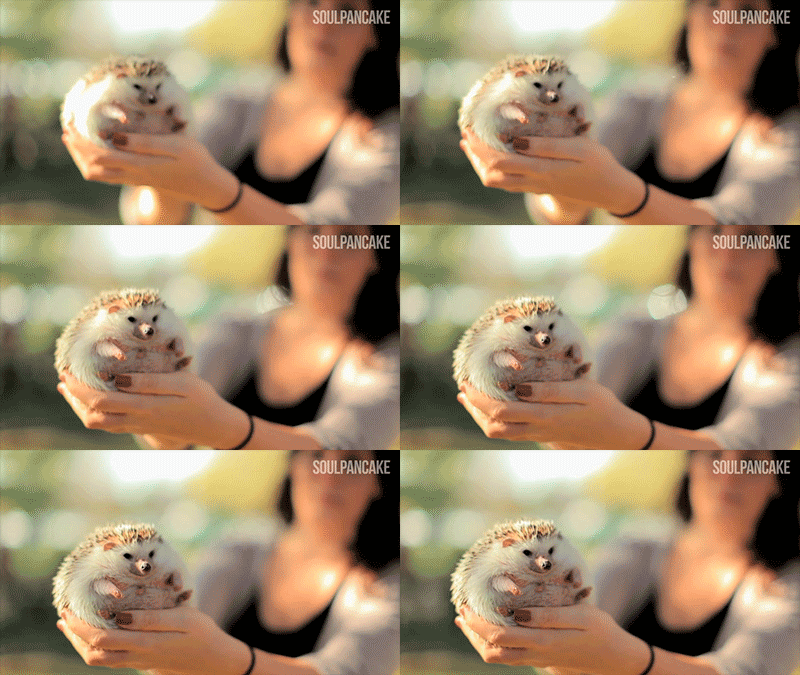
Hedgehog Ball GIF

They found that every limbed animal have this "sonic hedgehog" gene active. They tested it with many other animals and found that they all contained this same gene, all turned on.

ps. i can spell genes. the title was, although without reason, intentionally spelled that way. 

Wednesday, October 30, 2013

Survival of the Sickest: Jump into the Gene Pool


get it? man I am hilarious.

Anyways, chapter six of survival of the sickest focuses of the study of mutation and how the previous theories, that mutations were rare and random in time, was wrong. The truth about mutations is that it is constantly happening and will usually either have a harmful effect or no effect at all. In some rare cases, a random mutation will provide an advantage that will better the organisms chance to survive and thrive. This leads to natural selection which helps this mutation spread throughout a species, and boom, this is evolution.

This chapter also spoke of viruses and their ways of penetrating and getting into an animals system. A virus itself is not considered an animals though, because of it's inability to reproduce of their own. They actually have to find a "host cell" that it can use to multiply and then move into another cell.

To continue on this subject, the chapter discussed vaccines, and how we inject non-harmful viruses into our systems in order to scare away more dangerous viruses. At the beginning of this chapter,we are told of a the first man to discover a vaccine for a dangerous disease. Edward Jenner studied and found out that people contracted with cowpox were able to defend themselves from small pox. He decided to test this by exposing a few men to cowpox, in order to defend them from small pox. By doing this, he developed the first vaccine.

Lastly, Inherited traits were brought up. It brings up an old belief that off-springs inherit developed traits, and denies it. It your parent had something that they developed during their lifetime, that doesn't mean that you will be born with that trait.

This is quite an interesting book.

Monday, October 28, 2013

Atoms to Traits


  1. Explain the significance of Mendel.
    Mendelnted by breeding different peas. He found obvious morphological differences such as tall versus short stems, wrinkled versus smooth seeds, and many more. His experiments
  2. Draw the structure of DNA and who discovered this structure.
    discovered by James D. Watson
  3. Explain each of the five examples of variations that occur to DNA and give an example of each.
    Point Mutation - a single base-pair change.
    Insertion - the insertion/addition of a base-pair sequence into a gene
    Gene Copy Number - the duplication of entire genes by copying errors during cell division which can lead to differences between speciesDeletion - the absense of the sequences of base-pairsInversion - a chromosome rearrangment in which a segment of the chromosome is reversed end to end
  4. What is evo-devo?
  5. A category of evolutionary biology that concentrated on studying the effects of changes in important developmental genes and how they affect evolution. His experiments changed the general perception of heritable variants from ephemeral and blendable to discreet entities passed from parents to offspring, which are in fact presen
  6. Make a connection between human migration and the mutation of lactose intolerance.
    In the past, most humans were lactose intolerant in adulthood, because they only needed the nourishment of milk in their childhood. At some point in time, a genetic mutation formed that allowed us to handle the proteins in milk and use it as nourishment in our adulthood. This happened as our ancestors traveled to Europe, the Middle East, Africa, and on. Later in time, we were forced into an issue where we were forced to consume milk. This is how the genetic mutation formed.

Tuesday, October 22, 2013

-.- so there is no race.

Tuesday, October 22, 2013

Here is my response to this article.
Does Race Exists?

     Well does it? This is one question that applies to so many people. Well according to the article Does Race Exist, no it doesn't, well at least not for long.
     What does Race mean? Well today, we use race to classify each other based on looks. Some people have light skin, and some have dark. Some people have lower cheekbones, and some have higher ones. We classify each other by race because we thought that this was the only way to do it, but this article sheds some light on this topic. If you look at the genetics of each different "race," you will that looks have very little to do with how related or different they are. Instead of separating into races based on looks, geneticists can find out the relatedness of groups by looking at small variations in the DNA,know as polymorphisms. These polymorphisms are mostly neutral and do not directly affect any particular trait, but there are some polymorphisms in genes that can lead to genetic disease. In a perfect society, we would be able to use this method to genetically separate into groups. Sadly, we cannot do this. We have become too diverse and interbred to use this method.
    Both this article, Does Race Exist?, and the movie that we are watching in class, teach us that the relationships between man are much greater than just how they look and where they live. They both show us that the relationships lie within the blood. In the movie, The Journey of Man, blood is referred to as a "time machine." They tell us that we can look into the blood of different races to better our knowledge of where we all came from and how we got to where we are today. This article has very similar beliefs in that it says that humans are not simply separated by physical traits, but we can only see these connections through their DNA.
     After reading this article and watching this movie, I have decided that race does exist, but not in the way that we know it today. Race is actually based on our genetic make-up, because it is what's inside that counts.

Thursday, October 17, 2013

Well.........

Thursday, October 17, 2013:
I took a test. I think i did fine. We will see.

Tuesday, October 15, 2013

For Standard 9/1

I am here to correct my latest quiz, the Hardy Weinberg equilibrium quiz.

After Graduation, you and 19 friends build a raft, sail to a deserted island, and start a new population, totally isolated from the world. Two of your friends carry (that is, are heterozygous for) the recessive cf allele, which in homozygotes causes cystic fibrosis, Assuming that the frequency of this allele does not change as the population grows, what will be the instance of cystic fibrosis on your island?

Well at the time that I took this quiz, I was not too confident with my knowledge of the gene pool. 
So in this problem 2/20 people are heterozygous, which means that 2 out of the 40 alleles total that this group of people has, are recessive. In this problem, we are asked to find the instance of cystic fibrosis, or otherwise known as q^2.

So 2/40 is q.
So to find what q^2 is, we simple square 2/40.
so (0.05)^2 is equal to

0.0025.

When I first took this quiz, I was having trouble understanding this because my mind was aware of the fact that if a population has all homozygous dominant, except for two heterozygous, that you were able to say that 2 out of  these 40 alleles (2 per person) are recessive. As I was walking out of the Biology Classroom, this clicked in my head, but too late for it to make a difference in my quiz.

I reproduced in class today.

Tuesday, October 15, 2013:
Today was a fun class. A bit awkward, but fun. So, in an attempt to learn about recessive and dominant traits. We learned that homozygous dominant is when someone has AA or two dominant alleles. We also learned that homozygous recessive means that someone has aa or two recessive alleles. Then there are the Aa, or heterozygous. 

We then were taught the Hardy Weinberg Equilibrium. Basically, we used our first equation in this class, I think, p^2 + 2pq + q^2 to figure out the frequency that any of the above combinations would appear in a population.

We ended with one quiz, and were assigned another to take at home.

Wednesday, October 2, 2013

Shell and Brine....waggle

Wednesday, September 2, 2013:
Well today we finished a mini lab and then started a three day long lab.
So Mr. Quick started us on our mini-lab quickly. He threw a bag of assorted Croatian shells at us and asked that we split them into different categories. So my partner and I decided to split them up by their different looks.

In the end, we learned about adaption and how it is hereditary, but not always helpful.


Then we started our Brine Shrimp Lab, where we would observe Brine Shimp in different salt concentrations.

Monday, September 30, 2013

I have joined the Order of the Sirenia

Monday, September 30, 2013:
Today was an interesting and enjoyable day.
So Mr. Quick has been telling us about a project that we would be working on in the future where we would get to pretty much make up a new creature. Well That Time Has Come. We started of by choosing partners, mine being Chris Hernandez, and then we moved on to picking our creature.

We were LUCKY to get the coolest and most bad-ass creature in the sea....


this AMAZING fellow of the Order of the Sirenia
Manatee Eats Hand AIN'T HE JUST ADORABLE.

PS..As you can see, i finally figured out this GIF thing.
Anyway, back to the lab. So we were meant to look at the cladogram of the sirenia, choose another species with a common ancestor, compare the two, and then create the transition.

So we picked this little fellow as our other species.


So the point is that we have two adorable creatures to compare.
Well sadly my photo-shopping skills aren't too great and our transition ended up looking like this:


So if you would like to come and check out our website, go ahead!
https://sites.google.com/site/sireniantomanatee/

Thursday, September 26, 2013

Evidence for Evolution Quiz

Evidence of Evolution Quiz
1. Explain the following picture in terms evidence for evolution.

This picture shows that Evolution occurred. The Mesonychid, over the time span of millions of years, gradually changed from a land-dweller to an ocean-dweller.

2. Which of the following continents did marsupials begin from?
a. Europe
b. Africa
c. Australia
d. South America
e. North America

3. Comparing a dragonfly, bird, bats - explain the type of evolution that these organisms show.
When comparing these three organisms, we see that there are many similarities, but their underlying structures are completely different. This is called convergent evolution. These organisms share the analogous structure of wings.

4. Explain how the Common Descent Lab shows DNA evidence and ancestry as 
evidence for evolution. Include examples of Primates.
In the Common Descent Lab, we took four strands of DNA, a gorilla, a chimpanzee, a human, and a common ancestor, and look for similarities between them. We used similarities in the DNA to find common ancestry among these four organisms. One thing that we found was that, chimpanzees are more closely related to humans than gorillas are.

5. Explain homology using some examples from your readings.
Homology is an ancestral relationship between two or more organisms. We learned this after reading Your Inner Fish, where the author spoke of commonalities of arms between many different organisms, and then introduced the blob.


Monday, September 23, 2013

To Evolution! And On!

Monday, September 23, 2013:
So now what we have a general understanding of what Evolution is, we had to start finding connection. TO THE LAB!!

The lab of the day was to investigate the common descent of three completely different species: Gorillas, Chimpanzees, and, well, Humans. Our job was to synthesize our own DNA strand for each of the three species.


We could then compare these strands to the stand of a common ancestor and to each other. After looking at the strands we built, we found that:

Human DNA compared to:          Number of Matches
Chimps DNA                             15
Gorilla DNA                            10


We found that Chimps were more closely related to humans than chimps were, and concluded that the cladogram would pretty much look like this:


Thursday, September 19, 2013

My Best Bud.

Thursday, September 19, 2013:


To summarize this class into one picture:

So this is my best bud, Tiktaalik. He is pretty mucht the trasitional fossil that shows us the transformation from aquatic to land animals. As you can see by the picture, Tiktaalic was a pretty scary, alligator creature with wrists, a neck, and a developed rib-cage, all of which helped it crawl on land. 
Mr. Quick used this amazing creature to illustrate the importance of intermediate or transitional fossils. We learned that without finding a transition fossil like Tiktaalik, our fossil record is not complete. In modern day paleontology, he represents the direct relationship between land and aquatic animals.


Tuesday, September 17, 2013

The Test...

Tuesday, September 17, 2013:
Well....I just came out of the test. I'll just be honest, I didn't study for this as much as I should have. See what happened was what usually happens.

I had a friend who took the test a few blocks before us. He spent all night studying very hard, because he felt that he was unprepared for the test. When he sat down to take the test, he breezed through it. So this friend of mine walks out of biology and of course, I ask him how the test was, and then he replies, "Dang that was so easy! I don't know even know why I was up all night studying for that." So of course, my brain pretty much shuts out the idea of studying for the test. The truth was that my friend just studied so hard that he was really prepared for the test.

I don't really know why I am telling you this. I just know that this happens a lot. I think I should just stop asking how the test was. Maybe that will change some things. I don't know. Better luck next test.

Thursday, September 12, 2013

Review Sesh

Thursday, September 12, 2013:

Well, I kinda forgot to blog about this class, and I don't really remember what we did. So from what I remember...

We spent the beginning of class studying functional isomers and some other chemistry. Then, when we decided to move on. I was kind of taken by surprise when Mr. Quick said that we had a test next class. So, we reviewed for the test. We ended class with a quiz on functional isomers.

Silly Jerell

September 11, 2013
So today was quite a rushed class. My partner, Chris Hernandez, and I raced both the clock and Mr. Quick and Shannon to complete this mystery of a lab, who stole Jerell's iPod. Jerell works at McDonalds, and one day, when he returned to work after a break, his iPod was missing, with only a few food crumbs in its place. There are four possible suspects, Jose, Ashley, Bruce, and Kiara, and we are supposed to help Jerell test all of the foods that they ate that day, and compare it to the crumbs that were found.

In this lab, we took six solutions and tested them to see if they had starch, glucose, lipid, and protein. We found that the crumbs that were found contained Glucose, Protein, and Lipids, but not Starch. We then tested the foods that the suspects ate that day: Bean burrito with cheese, Fat-free Yogurt, Toast with butter and jelly, and Pretzel.

Our results are as follow:
Food
Glucose
Starch
Protein
Lipid
Pretzel
Yes
Yes
No
No
Butter
No
No
No
Yes
Jelly
Yes
No
No
Yes
Fat-free Yogurt
Yes
No
No
No
Beans
No
No
No
No

Based on these results, Bruce, with his Peanut Butter and Jelly sandwich, has the the meal that is the closest to the crumbs that were found.

BRUCE STOLE JERELL's iPod

Wednesday, September 11, 2013

House Case

September 10, 2013:
The main focus of today's class was the house case. If all house cases follow our first one, then a house case is when we are assigned someone with many symptoms, and we are supposed to try to figure out what he has.

House Case #1:
High School Senior
18 Years Old
Runs Cross Country
Symptoms:

  Vomiting
  Severe Headache
  Exhaustion
  Confusion

Additional Helpful Information:
  He is not on medications
  The symptoms began after practice
  The practice was in 104 degree weather
  Drank 3 gallons of water during practice

Based on this information, my class and I made a list of possibilities.

  1. Heat Exhaustion
  2. Heat Stroke
  3. Type 2 Diabetes
  4. Dehydration
  5. Over Hydration
We were then given a list of test results to further our search.
MRI and CAT scan-negative
CRC-normal and white blood cell numbers are normal
    Blood Glucose level-normal
    Serum/Blood Na levels 125 meq/L
    Serum Osmolality - decreased
Urinalysis - Specific Gravity decreased <100mOsm/kg and Urine Na decreased to 15 meq/L
Blood Pressure slightly elevated

After ruling out most of our prior possibilities, a few classmates and I have decided that his situation is most likely over-hydration.

This was my first house case, and I actually kind of enjoyed it. It was pretty interesting trying to figure out what was wrong with this guy with such few information.

I'll be back. Next time on House:

Monday, September 9, 2013

5 Part Lab Full of Fun.

September 6, 2013:
This post will completely summarize this big lab, but sadly, I am not done with my lab report yet. I will post it as soon as I finish the lab report.

See You Soon

Thursday, September 5, 2013

Osmosis and Diffusion

September 3, 2013:
This class was all about Osmosis and Diffusion. We spent most of the class discussing this topic, and ended with a lab to test our these properties.

So what exactly are Osmosis and Diffusion?

Diffusion:
Particles have the general desire to more from a higher concentration to a lower concentration. Diffusion is this movement, which can occur in any state, from a higher concentration regions to lower concentration regions.

For Example:
An Air Freshener being sprayed into the air, and then diffusing itself and spreading evenly in the air.


Osmosis:
Osmosis is a type of diffusion. It is specific to water and it's movement through a semi-permeable membrane. A semi-permeable membrane is a tissue that allows some substances to pass through, based on polarity and size. Osmosis is this movement from a higher concentration region, through the semi-permeable membrane, and to a lower concentration region.

For Example:
Osmosis is partially responsible for the absorption of soil water into plants, and also the rising of water through plants and to leaves.


Next, We put these two huge concepts into use. We had a five part lab to test osmosis and diffusion, but I will talk more about that in my next post.

Monday, September 2, 2013

Penny Lab

Friday, August 30, 2013:
Today, our lab was as simple as a penny, some H20, and toothpick. We were told to pile water onto the top of the penny, one drop at a time, until the surface tension gave in. 
Image of penny with convex bubble on top

We did this twice and then on the third time, we were asked to put as much water on the penny as we could without breaking the convex bubble. Once we had a penny with the largest amount of water that the surface tension could hold. We then tested how strong the bubble was by putting a toothpick sideways on top of the penny. The surface tension was strong enough that when the toothpick was put on top of the bubble, it stayed there unaffected. We learned from this lab, just how strong the supposed "weak" bonds in water actually are, because they were able to not only stay on the penny, but also withhold the toothpick that was set on top.


In spirit of our next cabbage lab, here is a picture of the cabbage merchant from Avatar the Last Airbender with his cabbages:
Look how happy he is!

Thursday, August 29, 2013

Basic Chem

Wednesday, August 28, 2013:
This class was a bit different. We spent the class reviewing chemistry by working on worksheets that refreshed out basic bonding memory. We had two worksheets, one on covalent bonds and one on ionic bonds. The first part of both of the worksheets involved finding the number of protons, electrons, valence electrons, electrons to fill the outer shell, and of oxidation. We also worked on some Lewis diagrams. After we completed these two worksheets, we had a small formative quiz on some Basic Chemistry.


I didn't know this class would have so much Chemistry.

Tuesday, August 27, 2013

Milk, Food Coloring, & Surfactants

Friday, August 23, 2013:
Bob Stoddard and I were assigned to figure out why the food coloring reacted the way it did in this experiment:
Dancing Milk
We were given the option to test anything pertinent in figuring out why the food coloring rapidly dispersed at the touch of the dish soap.

We hypothesized that this reaction happened at the bonding of the parts of the dish soap that lower the surface tension between two liquids and the fat in milk and that the fat there was in the milk, the more intense the reaction was. To test this hypothesis my partner and I repeated this experiment with three different milks: whole milk, 2% Milk, and Skim Milk.

We set up the three petri dishes with the three different milks and a few drops of food coloring in eah. We chose one soap and added a drop of it in each dish. We found that the:

Skim milk had a slow and short reaction.
2% milk had an instant and short reaction.
Whole Milk had an instant and long lasting reaction.


Our hypothesis was proved correct because the whole milk, having the most fat between the three, reacted the most intensely.

At the end of the block, the class came together and discussed what we found. Everybody had different test that all proved in one way or another that the reaction was caused between the dish soap and the lipids in milk. We learned that dish soap, along with detergent and other soaps, are called surfactants and they work as agents that can reduce the surface tension of a liquid and thus allow it to foam or penetrate solids. This proves why the food coloring moved the way it did.

Wonder what we are doing next class?